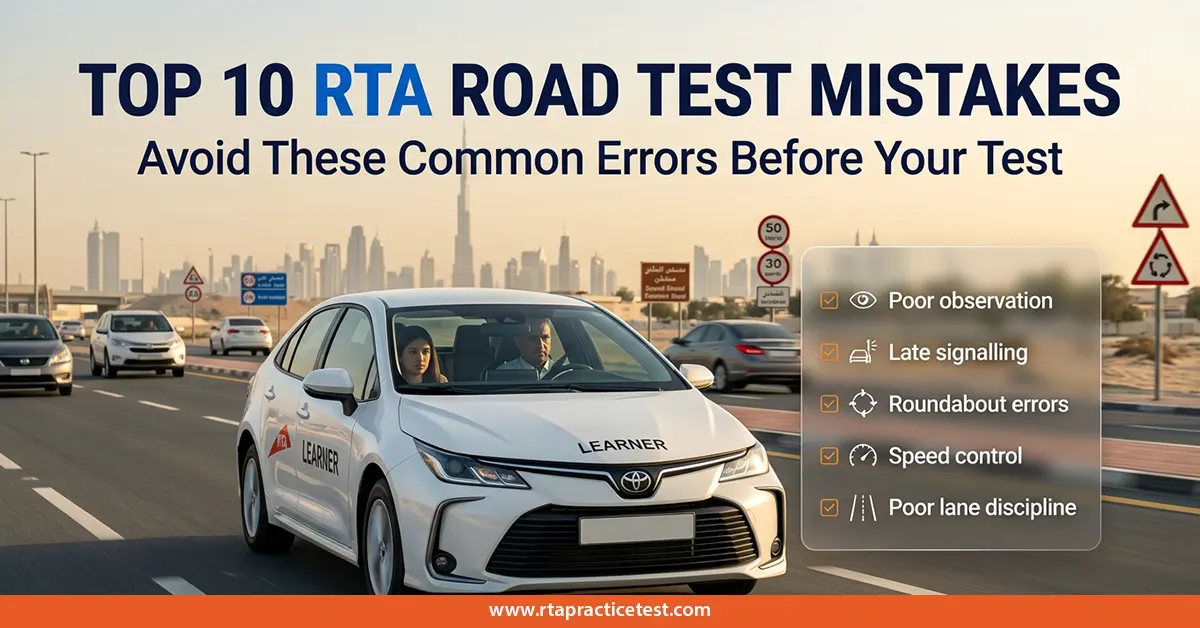
If you already know how to drive but keep worrying about the RTA final road test, you are not alone. Many learners do not fail because they cannot control the car. They fail because small habits become safety problems during the assessment.
A learner may drive perfectly for several minutes and then lose marks because they changed lanes without a clear blind-spot check. Another may know every road sign but hesitate at a junction, brake suddenly, or enter a roundabout without planning the correct lane.
That is why preparing for the RTA road test is about more than knowing traffic rules. You need to show safe decision-making consistently while the examiner is watching.
This guide covers the most common RTA road test mistakes, why they matter, how to correct them, and what you can do during your next practice session to reduce the chance of repeating them.
Important: Exact assessment criteria, test procedures and penalties can change. Always follow the current instructions given by your driving institute and the official Roads and Transport Authority (RTA). The RTA’s official portal is the best source for current licensing and testing information: Dubai RTA official website.
Why Good Drivers Still Fail the RTA Road Test
One of the biggest mistakes learners make is treating the road test like an ordinary driving trip.
It is not.
When you drive with family or friends, you might make a quick mirror check without thinking about it. During an assessment, however, your observation, positioning, signalling and decision-making need to be consistent and obvious.
Think of the examiner as evaluating your driving habits, not simply whether the vehicle moves from point A to point B.
For example:
You approach a lane change. You look in the mirror, signal, check your blind spot and move when there is a safe gap.
That is a complete driving process.
Now imagine you signal and immediately move because you assume the lane is empty. Even if nothing goes wrong, the examiner may consider the observation inadequate.
The difference is only a few seconds, but it can make a major difference to your assessment.
1. Poor Observation and Blind-Spot Checks
Poor observation is one of the most important areas to fix before the test.
The common mistake
Learners often:
- Look mainly at the road directly in front of them
- Check only the rear-view mirror
- Forget the side mirrors
- Change lanes without checking the blind spot
- Look for traffic only after beginning the manoeuvre
- Make very small head movements that do not clearly demonstrate observation
The dangerous part is that a learner may think they checked when they actually did not check thoroughly enough.
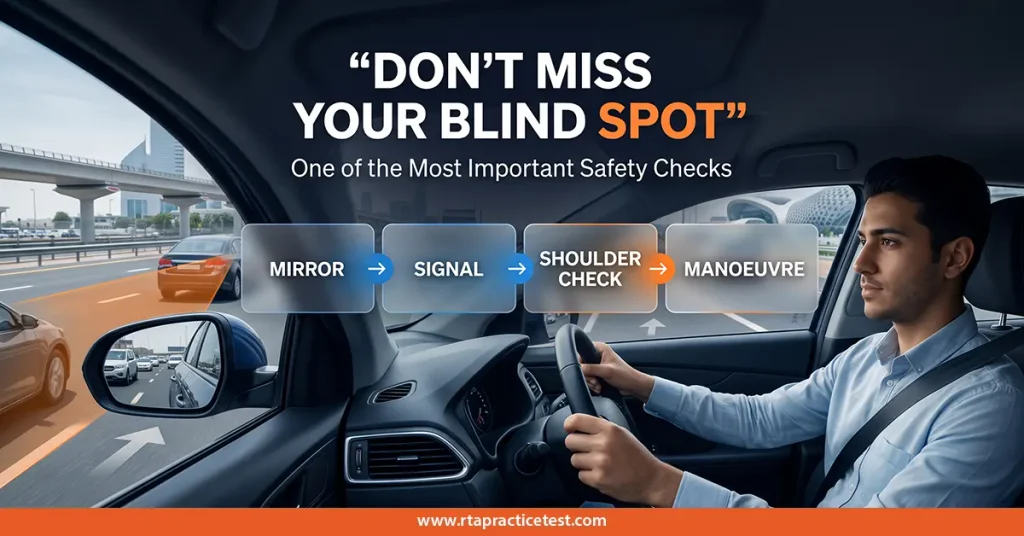
A better habit: Mirror → Signal → Blind Spot → Manoeuvre
Before changing lanes, develop a repeatable sequence:
1. Check the relevant mirror.
2. Signal your intention.
3. Check the blind spot.
4. Confirm the gap is safe.
5. Move smoothly.
Do not treat the signal as permission to move. A signal tells other road users what you intend to do; it does not give you priority.
Practical example
Suppose you are driving in the middle lane and need to move right.
You check the right mirror and see a vehicle some distance behind you. You signal. Before moving, you perform a blind-spot check. If the vehicle has moved into the area you cannot see properly in the mirror, you wait.
That final check can prevent a serious mistake.
Practice drill
During your next lesson, ask your instructor to monitor only your observation.
Do not try to fix ten things at once.
For one 20-minute drive, focus on:
- Mirror awareness
- Blind spots
- Junction scanning
- Pedestrian observation
- Vehicle movement around you
Once this becomes automatic, move on to another weakness.
2. Forgetting or Misusing Indicators
A surprising number of learners understand signalling but use it poorly under pressure.
Common RTA driving test mistakes include:
- Forgetting the indicator
- Signalling at the last moment
- Signalling after beginning the manoeuvre
- Using the wrong indicator
- Leaving the indicator on after completing the manoeuvre
The purpose of signalling is to give other road users enough information to understand your intention.
The better approach
Signal early enough for your intention to be clear, while still following the road layout and your instructor’s current guidance.
For lane changes, your process should look like:
Mirror → Signal → Blind spot → Safe gap → Lane change → Cancel indicator
Do not automatically use a fixed number of seconds in every situation. Road layout, traffic conditions and speed matter.
The important point is that the signal should precede the manoeuvre, not accompany it at the last second.
3. Making Mistakes at Roundabouts
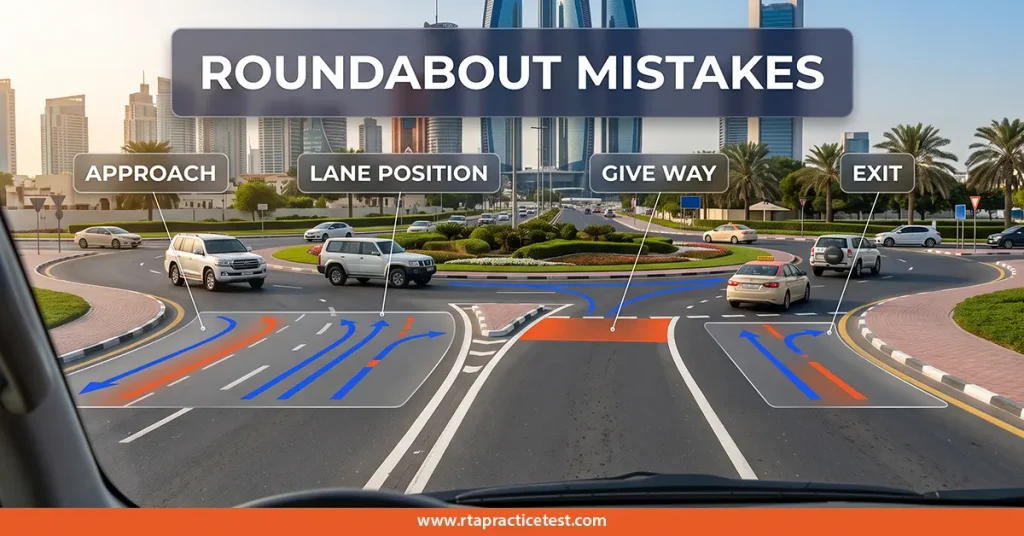
Roundabouts cause problems because they combine several skills:
- Lane selection
- Observation
- Yielding
- Speed control
- Steering
- Signalling
- Exit planning
A learner can know the roundabout rules and still make mistakes because they make the decision too late.
What commonly goes wrong?
Some learners:
- Approach too quickly
- Choose the wrong lane
- Fail to observe traffic already circulating
- Change lanes unnecessarily inside the roundabout
- Cut across another lane
- Forget the appropriate signal
- Focus so much on entering that they forget to prepare for the exit
How to improve
Start planning before entering the roundabout.
Ask yourself:
Where am I going? Which lane should I be in? What traffic do I need to give way to? When will I need to prepare for my exit?
Do not wait until you are already inside the roundabout to answer those questions.
A useful practice method
Ask your instructor to take you through several different roundabouts.
After each one, discuss:
- Which exit you needed
- Which lane you approached from
- What traffic you had to observe
- When you signalled
- Whether your lane position remained stable
This turns each roundabout into a learning exercise instead of simply repeating the same route.
4. Driving Too Fast or Too Slowly
Speed mistakes can work in both directions.
Exceeding the posted limit is obviously dangerous and can have serious consequences. But driving unnecessarily slowly can also create problems when the road and conditions are suitable for normal traffic flow.
The nervous-driver problem
Some learners become so worried about speeding that they spend the entire test watching the speedometer.
That creates another problem: reduced attention to the road.
Instead, develop a balanced habit.
Use this sequence
Read the road → Check signs → Assess traffic → Set an appropriate speed → Continue scanning
Your speed should be appropriate for:
- The posted limit
- Traffic conditions
- Visibility
- Road layout
- Junctions
- Pedestrians
- Weather and surface conditions
Do not assume that driving exactly at a particular speed is always appropriate simply because the number appears on a sign.
Safe driving requires continuous assessment.
5. Hesitation and Nervous Braking
This is particularly common among learners who have already failed once.
They start thinking:
“What if I make another mistake?”
That thought can make normal decisions feel much more complicated.
What hesitation looks like
You may:
- Stop unnecessarily when the road is clear
- Brake sharply because you become unsure
- Wait too long at a junction
- Accelerate and immediately brake
- Freeze when another vehicle approaches
- Take too long to complete a safe manoeuvre
The goal is not to drive aggressively.
The goal is to make calm, safe and predictable decisions.
Replace panic with observation
Instead of thinking:
“Should I go? Should I stop? What will the examiner think?”
Think:
“What is happening around me, and what is the safest legal action?”
That small mental change can make driving much easier.
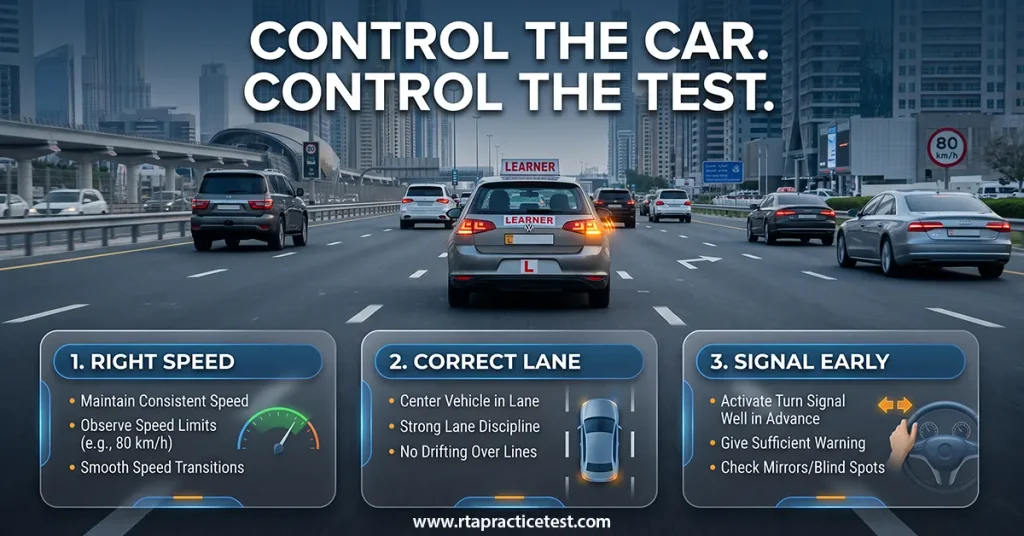
6. Poor Lane Discipline and Vehicle Positioning
Your vehicle should have a clear and controlled position on the road.
Common mistakes include:
- Drifting toward lane markings
- Driving too close to the curb
- Moving between lanes unnecessarily
- Turning from an unsuitable lane
- Taking corners too widely
- Positioning too late before a turn
- Failing to maintain a stable lane
Look farther ahead
One simple technique is to stop staring directly at the front of the car.
Your eyes should continuously scan farther along the road.
When you look ahead, you have more time to notice:
- Lane changes
- Junctions
- Traffic lights
- Pedestrians
- Road markings
- Vehicles slowing down
- Obstacles
Your hands then have more time to make small steering corrections instead of large, sudden movements.
7. Parking and Manoeuvring Mistakes
Parking is another area where nervous learners often lose control of the situation.
Common RTA parking test mistakes include:
- Starting a manoeuvre without proper observation
- Turning too early or too late
- Hitting the curb
- Moving too quickly
- Forgetting surrounding vehicles
- Failing to correct the position calmly
- Becoming so focused on parking that observation stops
The important rule
Do not rush because you think the examiner expects you to finish quickly.
A controlled manoeuvre is more important than an unnecessarily fast one.
Before moving:
Check → Signal if required → Observe → Manoeuvre slowly → Correct position → Secure the vehicle
Your instructor can also help you identify the exact reference points used by your training school for the particular parking manoeuvre.
8. Ignoring Pedestrians and Vulnerable Road Users
Pedestrian crossings require serious attention.
A learner may focus on vehicles and completely miss a pedestrian approaching or crossing the road.
Before proceeding near a pedestrian crossing, scan carefully.
Look for:
- People approaching the crossing
- People already crossing
- Children
- Cyclists
- Motorcycles
- Vehicles that may obstruct your view
Do not assume that because another vehicle has continued, you can automatically continue too.
Your own observation matters.
For additional preparation, reviewing RTA road signs and traffic rules can help reinforce the knowledge behind your practical decisions.
9. Failing to Check Seat Belts and Basic Safety
Basic safety checks can be overlooked because learners are concentrating so heavily on the actual driving.
Before moving the vehicle, make sure the required safety preparations have been completed.
A useful pre-drive routine is:
- Adjust your seat.
- Adjust mirrors.
- Fasten your seat belt.
- Confirm passengers are secured as required.
- Check the surrounding area.
- Start the vehicle safely.
- Move off only when it is safe.
The more automatic this routine becomes, the less likely you are to forget it under pressure.
10. Making One Small Mistake and Then Mentally Giving Up
This is one of the most damaging psychological mistakes.
Imagine you make a minor error early in the test.
You immediately think:
“That’s it. I’ve failed.”
From that moment, your concentration drops.
You start thinking about the previous mistake instead of the road ahead. Then you make another mistake because you are distracted.
That is how one small error can turn into several.
Use the reset technique
If something goes wrong:
Acknowledge → Correct if necessary → Breathe → Continue
Do not replay the mistake in your head.
The examiner is assessing your driving, not your ability to remain perfectly mistake-free every second.
A calm recovery is much more useful than panic.
Major Faults vs. Minor Mistakes: What Should You Worry About?
Learners often search for a specific number of mistakes they are “allowed” to make.
That can be misleading.
There is an important difference between a minor driving error and an action that creates an immediate safety risk.
A minor issue may involve something such as inconsistent positioning or an observation habit, depending on the assessment criteria.
A serious fault can involve creating a dangerous situation, violating a critical traffic rule, or requiring intervention.
Because RTA assessment procedures can change, do not rely on an unofficial internet list claiming that “X minor mistakes always means failure.”
Your driving school and the current RTA testing requirements should be treated as the authoritative source.
For official licensing information, refer to the Dubai RTA driving licence services.
Immediate Failure Risks You Should Never Take
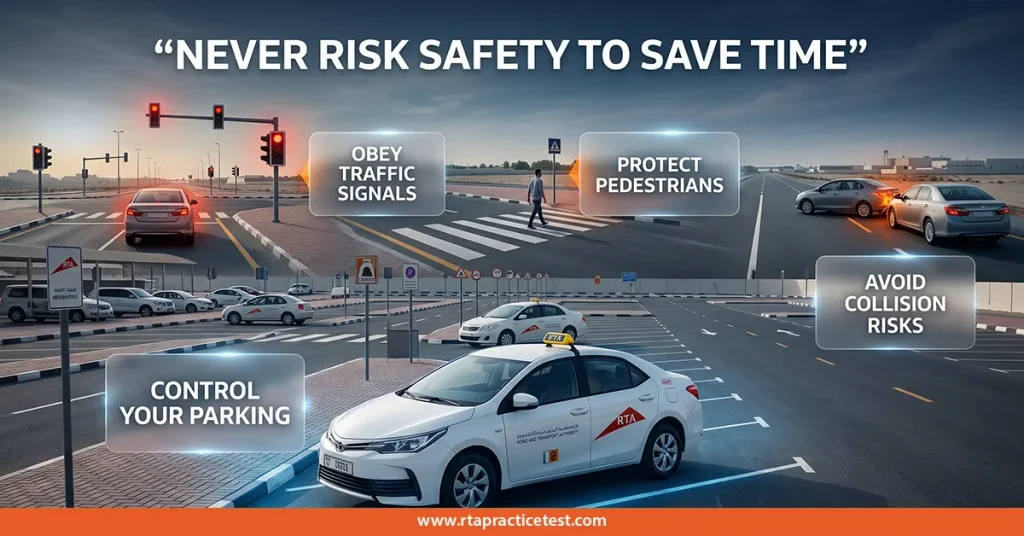
Some situations are far more serious than ordinary imperfections.
Examples of high-risk behaviour include:
- Running a red traffic signal
- Failing to obey a stop instruction
- Creating a collision risk
- Forcing another road user to brake or swerve
- Failing to give way where required
- Striking an object or curb during a manoeuvre
- Dangerous lane changes
- Ignoring pedestrians when required to yield
The exact consequences depend on the current RTA assessment rules and circumstances.
The safest strategy is simple: never try to “save time” by taking a risky gap or forcing a manoeuvre.
What to Do If You Failed Your RTA Road Test
Failing once does not necessarily mean you are a bad driver.
Instead of immediately booking another test and repeating the same routine, find the reason behind the failure.
Step 1: Review your assessment
Look at the feedback or assessment information provided after the test.
Identify the areas that caused problems.
Was it:
- Observation?
- Lane changes?
- Roundabouts?
- Parking?
- Speed?
- Signalling?
- Junctions?
- General vehicle control?
Step 2: Pick your top three weaknesses
Do not try to fix everything simultaneously.
For example:
Problem 1: Blind-spot checks
Problem 2: Roundabout lane selection
Problem 3: Nervous braking
These become your training priorities.
Step 3: Practice the weakness deliberately
Tell your instructor exactly what you want to improve.
Instead of saying:
“I want another normal lesson.”
Say:
“I want today’s lesson to focus on lane changes and blind-spot observation.”
That makes the lesson more useful.
Step 4: Simulate the test
Ask the instructor to conduct a mock test.
During the mock test:
- Minimize unnecessary conversation
- Follow normal road conditions
- Use the same observation habits
- Practice parking
- Practice roundabouts
- Practice lane changes
- Review mistakes afterward
You can also use a simple phone voice memo after the lesson to record the three things you need to improve. Do not operate or handle the phone while driving.
A Simple RTA Road Test Preparation Routine
If your test is approaching, use this routine during your final practice sessions.
Before driving
- Adjust seat
- Adjust mirrors
- Fasten seat belt
- Check passengers
- Take a breath
- Start calmly
During normal driving
- Scan ahead
- Check mirrors regularly
- Maintain lane position
- Watch road signs
- Monitor speed
- Look for pedestrians
- Anticipate traffic
Before changing lanes
Mirror → Signal → Blind spot → Safe gap → Manoeuvre
Before turns
Read signs → Choose correct lane → Observe → Signal → Turn safely
At roundabouts
Plan lane → Observe → Yield where required → Enter safely → Maintain lane → Prepare for exit
During parking
Observe → Control speed → Manoeuvre smoothly → Check surroundings → Correct calmly
If you make a mistake
Do not panic. Reset and continue.
How to Pass the RTA Road Test With Better Preparation
There is no legitimate trick that guarantees a pass.
The most reliable approach is to make safe driving habits automatic.
If theory knowledge is one of your weak points, practice with free RTA theory test questions before your road lessons.
You can also review Dubai road rules practice questions to strengthen your understanding of signs, lane rules and traffic situations.
If you struggle specifically with signs, use RTA road signs practice tests and then discuss any confusing signs with your instructor.
The important connection is this:
Theory tells you what the rule means. Practice teaches you when to apply it.
Frequently Asked Questions About RTA Road Test Mistakes
What is the most common reason people fail the RTA road test?
There is no single mistake that causes every failure. Poor observation, unsafe lane changes, incorrect positioning, roundabout errors, signalling problems and poor decision-making are among the areas learners commonly need to improve.
The specific reason for an individual failure should be taken from the assessment feedback and instructor evaluation.
How many minor mistakes are allowed in the RTA road test?
There is no safe universal number that candidates should rely on. The outcome depends on the type, frequency and seriousness of errors and the applicable assessment criteria.
A candidate should focus on safe, consistent driving rather than trying to calculate how many mistakes they can make.
What is the biggest mistake during a lane change?
Moving before properly checking the blind spot is one of the most serious habits to eliminate.
Use:
Mirror → Signal → Blind spot → Safe gap → Manoeuvre.
How can I stop getting nervous during the RTA test?
Do not try to eliminate nervousness completely.
Instead, create a predictable routine.
Practice the same observation sequence, take controlled breaths before moving off, and concentrate on the next driving decision rather than the final result.
Should I take extra classes after failing the RTA road test?
Extra lessons can be useful if they target the actual weaknesses that caused the failure.
Taking more lessons without identifying the problem may simply repeat the same mistakes.
Ask your instructor to focus your next sessions on the areas identified in your assessment.
How many times can I retake the RTA road test?
etake procedures and requirements can depend on your licensing pathway and current RTA rules. Check the latest requirements with your driving institute or the official RTA website .
Can one small mistake automatically fail the road test?
Not every small mistake is automatically a failure. However, a mistake that creates a serious safety risk can have much more serious consequences.
The best approach is not to drive as though you are trying to avoid a particular number of faults. Drive safely and consistently from the beginning to the end of the test.
Final Thought
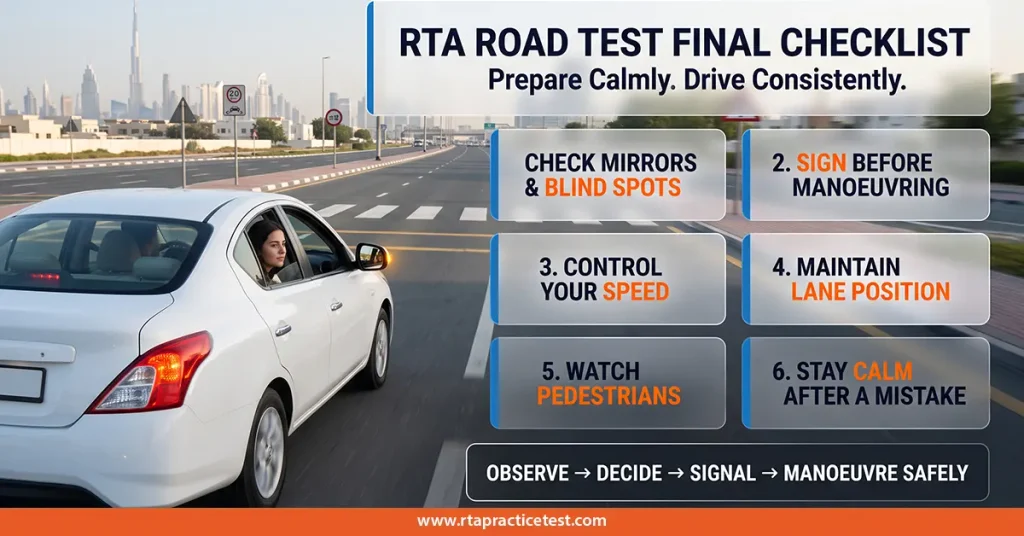
The biggest change most learners need before the RTA road test is not another hour of memorizing rules. It is learning to turn those rules into visible driving habits.
Check your mirrors. Look at your blind spots. Signal before manoeuvring. Choose your lane early. Control your speed. Read the road ahead. Give pedestrians and other road users the space they need. And when something does not go perfectly, reset instead of panicking.
If you have already failed an RTA test, use that experience as information. Identify the exact pattern that caused trouble, practice that weakness deliberately, and then test yourself under realistic conditions.
The goal is not to perform a perfect drive because you are afraid of the examiner. The goal is to develop such consistent observation and decision-making that safe driving becomes your normal driving.