RTA Practice Test

Master the RTA Theory Test and Walk Into Exam Day With Confidence

Getting your UAE driving license starts with strong theory knowledge. At RTA Practice Test, we help learners understand road signs, traffic laws, hazard awareness, safe driving behavior, and the key topics commonly covered in UAE driving theory exams. Whether you are preparing in Dubai, Abu Dhabi, and Sharjah, RTA Practice Test gives you a complete roadmap to study better and feel ready.

Choose Your Emirates

We aim to support learners from different emirates and license categories by offering useful theory preparation content relevant to common UAE driving topics.


dubai driving test

Dubai RTA Theory Test

abu dhabi test

Abu Dhabi RTA Practice Test

sharjah driving test

Sharjah RTA Theory Test

Everything You Should Study for the RTA Theory Test

Good preparation is not about rushing through sample questions. It is about understanding the major subject areas that appear repeatedly in theory learning.

Road signs and their meanings

Road signs are one of the most important parts of theory preparation. You need to recognize signs quickly and understand what action they require from a driver.

Traffic rules and road behavior

Every learner should understand how rules apply in real situations, not just in theory. This includes how to behave near junctions, how to follow lane discipline, and how to react safely around pedestrians and other road users.

Traffic signals and road markings

Signals and markings work together to guide road users. The theory test expects learners to understand what each signal or line means and how to respond without hesitation.

Hazard awareness and defensive driving

This area is essential because theory learning is not only about law. It is also about staying alert, predicting risk, and taking the safest possible action before danger develops.

Understanding Traffic Signals the Right Way

Traffic signal questions often seem simple, but they test whether you understand judgment, timing, and safe decision-making.

Red Light

Stop fully and wait until it is safe and permitted to proceed.

Green Light

Proceed carefully when your route is clear and it is safe to move.

Yellow Light

Prepare to stop safely unless sudden braking would create more danger.

Flashing or Directional Signals

Stay alert, follow the indicated movement, and check surrounding traffic carefully.

Important Road Signs You Should Know

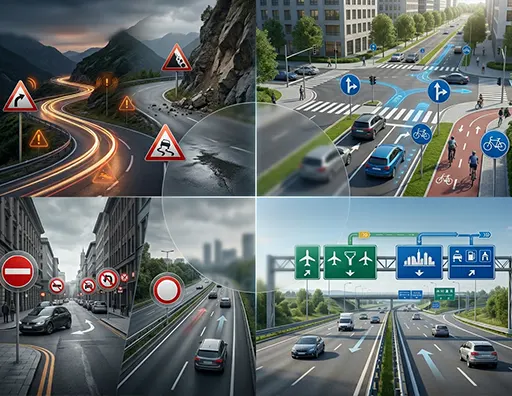
Many learners struggle with signs because they try to memorize too quickly. A better approach is to group them by purpose and meaning.
Warning Signs

These signs alert drivers to possible hazards ahead.

Example:

Pedestrian crossing, curve ahead, school zone, roundabout ahead, road narrows

Mandatory Signs

These signs tell you what you must do.

Example:

Keep left, turn right only, turn left only, minimum speed direction

Prohibitory Signs

These signs show restrictions or actions that are not allowed.

Example:

No entry, no U-turn, no overtaking, no parking

Informational / Guide Signs

These signs provide route, direction, or service information.

Example:

Parking zones, directions, exits, public facilities

Important Road Signs You Should Know

Who Can Use This RTA Practice Test?

Why RTA Practice Tests Help Before the Real Exam

Practice makes a real difference when it is done properly. Repeating questions alone is not enough. You need to understand why an answer is correct.

Benefits of regular practice

How to use practice tests effectively

RTA Theory Test Day Tips

Good performance is not only about what you studied. It is also about how calmly and carefully you approach the test itself.

Before the test

During the test

FAQ,s

What is the RTA Theory Test?

The RTA Theory Test is a written knowledge exam required to obtain a UAE driving licence. It assesses your understanding of road signs, traffic laws, road markings, hazard awareness, and safe driving practices before you begin practical driving.

Why is the RTA Theory Test important?

The RTA Theory Test ensures that learner drivers understand essential traffic rules and road safety principles. Passing the test demonstrates that you have the knowledge needed to drive responsibly and safely on UAE roads.

What subjects should I study for the RTA Theory Test?

You should study road signs, traffic signals, road markings, speed limits, right-of-way rules, lane discipline, hazard perception, defensive driving, parking regulations, and general road safety.

What types of road signs are included in the RTA Theory Test?

The theory test commonly includes warning signs, mandatory signs, prohibitory signs, guide signs, temporary road signs, and road markings. Understanding their meanings and how to respond is essential for success.

How do practice tests improve my RTA Theory Test preparation?

Practice tests help you become familiar with exam-style questions, identify weak areas, reinforce important traffic rules, improve road sign recognition, and build confidence before the official test.

What mistakes should I avoid during the RTA Theory Test?

Avoid rushing through questions, guessing without reading carefully, overlooking road sign details, and ignoring safety principles. Take your time, read each question thoroughly, and choose the safest answer.

How can I remember UAE road signs more easily?

Group road signs by category, such as warning, mandatory, prohibitory, and guide signs. Review them regularly and reinforce your learning with practice questions that explain each sign's meaning.

What should I do on the day of my RTA Theory Test?

Get enough rest, arrive early, stay calm, review key traffic rules and road signs, read every question carefully, and use logical decision-making based on safe driving practices.

Who can benefit from using RTA Practice Tests?

RTA Practice Tests are suitable for first-time drivers, UAE residents, expatriates, and anyone preparing for a Light Motor Vehicle (LMV), motorcycle, bus, or heavy vehicle theory test.

How can I improve my chances of passing the RTA Theory Test?

Study consistently, understand traffic laws instead of memorizing answers, review your mistakes, practice regularly, and focus on weak topics such as road signs, traffic signals, and hazard awareness.