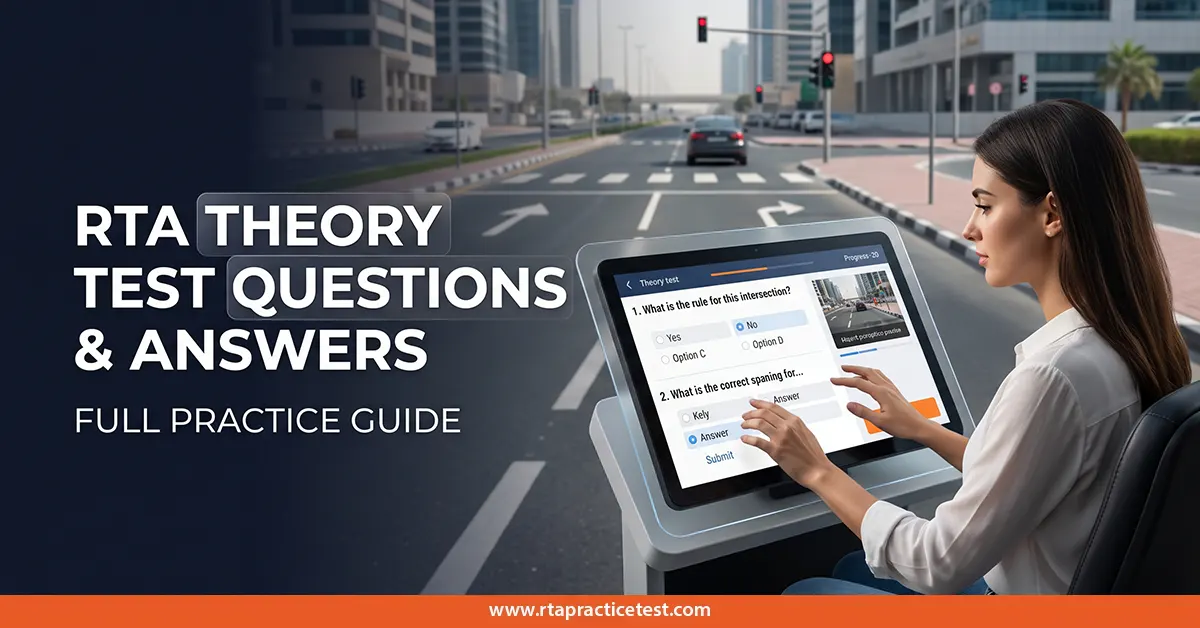
If you are preparing for the Dubai driving licence, the RTA theory test is one of those stages that looks easier than it actually feels.
The questions are not only about recognizing a STOP sign or knowing that a red light means stop. Many questions test what you would actually do in a situation: entering a blocked intersection, changing lanes near a hazard, approaching a roundabout, following a heavy vehicle, or reacting to a pedestrian who suddenly appears.
That is why simply memorizing answers is not the best preparation strategy.
This guide covers RTA theory test questions and answers, common road-rule scenarios, traffic signs, hazard perception, and practical techniques you can use before your test. It is designed around the needs of learners preparing for the Dubai Light Motor Vehicle (LMV) theory test.
Important: Test procedures, question formats, scoring rules, and available languages can change. Always confirm the latest details with your driving institute and the official RTA channels before your appointment.
RTA Theory Test: What You Should Know Before Practicing
The Dubai RTA theory assessment is designed to check whether you understand the rules and can make safe decisions on the road.
For many learners, the difficult part is not knowing individual rules. It is applying those rules quickly when several things happen at once.
Based on the test information commonly provided to learners, the assessment includes multiple-choice questions and hazard-awareness material. A commonly referenced format is 40 questions, with a passing requirement of 30 correct answers. However, candidates should verify the exact current test structure with their driving school or RTA because testing arrangements can be updated.
Key areas to prepare
Focus your revision on:
- Traffic signs and road markings
- Intersections and right-of-way
- Roundabouts
- Lane discipline
- Safe following distances
- Speed management
- Pedestrian safety
- Overtaking
- Parking and stopping rules
- Mobile-phone and distraction rules
- Hazard perception
- Emergency situations
- Defensive driving
The official RTA Light Motor Vehicle Handbook should remain your primary study reference because third-party practice websites can contain outdated or incorrectly worded questions.
Official source: Dubai Roads and Transport Authority (RTA)
RTA Theory Test Questions and Answers
The following practice questions are designed to test the type of reasoning you need rather than encourage blind memorization.
1. What should you do when approaching a red traffic light?
Answer: Stop completely before the stop line and wait for the appropriate signal to proceed.
Why?
A common beginner mistake is slowing down without making a complete stop, particularly when the road appears empty.
Imagine you are approaching an intersection at 2:00 AM and there is no traffic around you. The correct response does not change simply because the road is empty.
Practical tip: When practicing, train yourself to identify the stop line first—not just the traffic signal.
2. You have a green light, but traffic has stopped on the other side of the intersection. What should you do?
Answer: Wait before entering if there is not enough space to clear the intersection.
A green signal does not mean you should enter an intersection and become stuck in the middle.
This is especially important at busy Dubai junctions during peak traffic.
The mistake learners make
They see green and immediately accelerate.
A better approach is:
- Check the signal.
- Look beyond the intersection.
- Determine whether there is enough space.
- Enter only when you can proceed without blocking the junction.
3. Who normally has priority when entering a roundabout?
Answer: Traffic already circulating in the roundabout generally has priority, subject to the signs, markings, and lane arrangements at that particular roundabout.
Before entering, slow down and check traffic coming from your left.
Example
You approach a two-lane roundabout and see a vehicle already circulating.
Do not assume that having a clear entry lane gives you priority. You need to assess the circulating traffic and follow the road signs and lane markings.
Remember: Roundabout questions often test observation and priority, not simply speed.
4. When should you give way to pedestrians?
Answer: Give way where pedestrians have priority, including designated pedestrian crossings, and take particular care around schools, residential areas, and locations where pedestrians may enter the road.
A pedestrian standing near a crossing should immediately make you more alert.
Real-world example
You are approaching a zebra crossing and notice someone preparing to cross.
Reducing speed early gives you more time to stop smoothly instead of braking suddenly at the crossing.
5. Is driving under the influence of alcohol permitted in the UAE?
Answer: No. Driving under the influence of alcohol is prohibited and can result in serious legal consequences.
Do not treat this as a question about whether you “feel okay” to drive.
Even if someone believes they are capable of driving, impairment can affect:
- Reaction time
- Concentration
- Judgment
- Coordination
- Risk assessment
For the theory test, the safe answer is straightforward: never drive under the influence.
6. What should you do if your vehicle breaks down on a highway?
Answer: If possible and safe, move the vehicle to a safe location such as the hard shoulder, activate hazard warning lights, and take appropriate warning and safety measures.
Do not stand unnecessarily close to moving traffic.
A useful memory sequence
Warn → Move → Protect
- Warn other road users using hazard lights and appropriate warning equipment.
- Move away from the traffic lane if it is safe.
- Protect yourself and passengers from approaching traffic.
Your exact response should depend on the location and circumstances.
RTA Traffic Signs Test With Answers

Traffic signs are among the easiest marks to improve if you study them by category instead of memorizing individual pictures.
Regulatory signs
These generally communicate rules, restrictions, or mandatory actions.
Examples include:
- Stop
- Give Way
- No Entry
- Speed limits
- No overtaking
- Turn restrictions
- Parking restrictions
When you see a regulatory sign, ask yourself:
What action does this sign require me to take?
Warning signs
Warning signs alert drivers to hazards or changes in road conditions.
You may encounter warnings for:
- Sharp bends
- Pedestrian activity
- Road narrowing
- Merging traffic
- Intersections
- Slippery roads
- Uneven surfaces
- Other hazards
The important point is that a warning sign is telling you to prepare, not panic.
Example
If a warning sign indicates a sharp bend ahead, your response should begin before reaching the bend.
Reduce speed, assess your lane position, and maintain control.
Guide and information signs
These signs help drivers understand:
- Directions
- Destinations
- Routes
- Exits
- Major roads
- Services
- Motorway or freeway information
For the theory test, don’t only memorize colors. Look at the entire sign and understand what information it provides.
Road Markings You Should Not Ignore
Many learners spend hours studying signs but give less attention to road markings.
That can be a mistake.
Questions can test your understanding of:
- Lane lines
- Solid lines
- Broken lines
- Stop lines
- Give-way markings
- Pedestrian crossings
- Yellow box markings
- Lane arrows
- Parking markings
Can you cross a solid line?
Do not assume that every solid line has exactly the same meaning in every situation. The correct interpretation depends on the road marking, location, signs, and road layout.
For your test, study the specific markings shown in the official RTA handbook rather than relying on a simple rule such as “never cross any solid line.”
This is an important example of why the official handbook is more reliable than random social-media quiz posts.
Hazard Perception: The Section Many Learners Underestimate

Hazard perception is different from ordinary multiple-choice revision.
You are not simply remembering a definition. You need to recognize a developing risk.
For example, imagine you see:
- A vehicle braking several cars ahead
- A pedestrian near the edge of the road
- A motorcycle in a blind spot
- A vehicle moving unexpectedly between lanes
- A car approaching quickly from behind
- A road narrowing ahead
The hazard may not have become an emergency yet.
Your job as a defensive driver is to identify the potential problem early.
How to practice hazard perception
When watching a driving video, do not stare only at the car directly ahead.
Use a scanning pattern:
Far ahead → mirrors → sides → immediate road → far ahead again
Ask yourself:
“What could force me to brake or change direction in the next few seconds?”
That question develops the type of observation needed for hazard awareness.
A common mistake
Some learners wait until a hazard becomes obvious.
For example, they notice a pedestrian only after the person steps onto the road.
A better driver notices the pedestrian standing close to the road and prepares before the situation becomes dangerous.
RTA Theory Test Questions About Mobile Phones
Can you use a handheld mobile phone while driving?
Answer: You should not use a handheld mobile phone while driving.
Mobile-phone use creates both visual and mental distraction.
Even a quick message can cause you to miss:
- A traffic signal
- A pedestrian
- A lane change
- A motorcycle
- A vehicle braking ahead
Test strategy
When a question involves a handheld phone, don’t look for a clever exception.
Think about the principle being tested:
Safe driving requires your full attention.
Always follow the current UAE traffic regulations and the wording provided in your official learning materials.
Safe Following Distance: Why Tailgating Appears in Theory Questions
One of the most useful concepts to understand is following distance.
If you drive too close to the vehicle ahead, you have less time to react when it brakes.
This becomes particularly dangerous at higher speeds.
The three-second method
Choose a fixed object such as:
- A road sign
- A lamp post
- A bridge
- A road marking
When the vehicle ahead passes it, begin counting:
One thousand and one, one thousand and two, one thousand and three.
If your vehicle reaches the same point before you finish counting, increase the gap.
Remember that adverse conditions may require more distance.
Heavy Vehicle Questions
How should you position yourself behind a heavy truck?
Answer: Maintain a safe following distance and avoid staying in areas where the truck driver’s visibility is restricted.
A useful defensive-driving principle is:
If you cannot see the truck driver’s mirrors, there is a good chance the truck driver cannot see you.
Heavy vehicles have larger blind spots and require more distance to stop.
Practical example
You are following a large truck on a highway.
Instead of driving directly behind its rear bumper, create additional space. If the truck brakes suddenly, that extra distance gives you more time to react.
How to Study RTA Theory Test Questions Efficiently
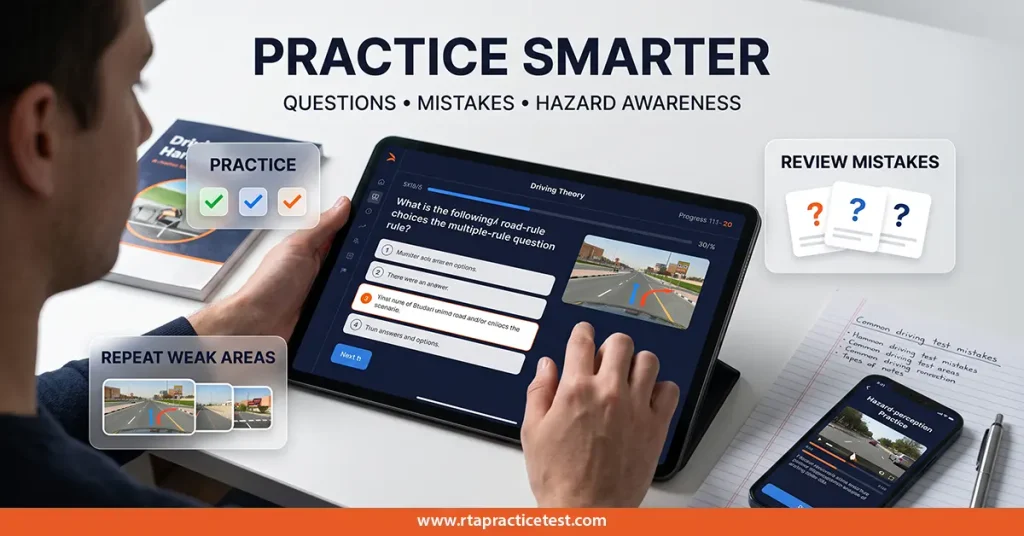
Reading 100 pages in one sitting is rarely an effective way to remember everything.
Try this approach instead.
Step 1: Read the official handbook
Start with the RTA Light Motor Vehicle Handbook provided through your driving institute or official RTA resources.
Don’t just read it from beginning to end.
Mark sections dealing with:
- Road signs
- Road markings
- Intersections
- Roundabouts
- Lane changes
- Overtaking
- Pedestrians
- Parking
- Emergencies
- Defensive driving
Step 2: Build a mistake list
Every time you answer a practice question incorrectly, write down:
Question → Your answer → Correct answer → Why you were wrong
For example:
Question: Can I enter a blocked intersection when the light is green?
My answer: Yes, because the signal is green.
Correct: Wait if there is insufficient space to clear the intersection.
Why I was wrong: I focused on the signal but ignored traffic conditions.
This method is much more useful than simply clicking “next question.”
Step 3: Practice signs separately
Spend one session only on signs.
Then test yourself without looking at the answer.
Try to identify:
- The sign category
- Its meaning
- The action required
- The hazard or restriction involved
Step 4: Practice under time pressure
During practice sessions, aim to answer straightforward questions quickly while leaving enough mental capacity for scenario-based questions.
The goal is not to rush.
The goal is to avoid spending several minutes on one confusing question and then becoming anxious about the remaining questions.
RTA Dubai Theory Test Practice: Common Mistakes
Mistake 1: Memorizing answers without understanding the scenario
Third-party quizzes sometimes phrase questions differently.
If you memorize:
“Answer B is correct.”
you may struggle when the same road situation appears with different wording.
Instead, memorize the rule behind the answer.
Mistake 2: Ignoring road markings
Signs are visually attractive and easy to study.
Road markings are less exciting, but they are equally important.
Spend dedicated revision time on lines, arrows, stop markings, pedestrian crossings, and yellow box junctions.
Mistake 3: Treating every green light as permission to proceed
A green signal does not remove the need for observation.
Look ahead.
If traffic is blocking your exit, wait until you can safely clear the intersection.
Mistake 4: Practicing only easy questions
If you consistently score 90% on basic sign questions, stop spending all your study time there.
Move to scenario questions.
Ask yourself:
- What would I do first?
- Who has priority?
- What is the developing hazard?
- Where should I position my vehicle?
- What could happen if I continue?
That is closer to real driving.
RTA Theory Test Questions: Quick Practice Set
Use these without looking at the answers first.
Question 1
You approach a red traffic signal. What should you do?
Answer: Stop before the stop line and wait for the appropriate signal.
Question 2
The traffic signal is green, but vehicles are blocking the intersection. What should you do?
Answer: Wait before entering until there is sufficient space to proceed.
Question 3
You are approaching a pedestrian crossing and see someone preparing to cross. What should you do?
Answer: Slow down, remain alert, and give way where the pedestrian has priority.
Question 4
What is a major danger of following a heavy truck too closely?
Answer: Reduced visibility and insufficient stopping/reaction distance.
Question 5
What is the safest response to a developing hazard?
Answer: Identify it early, reduce risk, and be prepared to slow or stop.
Question 6
What should you do if your vehicle breaks down in a dangerous location?
Answer: Activate hazard lights and, if safe, move to a safer position away from moving traffic while following emergency procedures.
Question 7
What does a warning sign generally tell you?
Answer: A potential hazard or change in road conditions is ahead.
Question 8
Why is tailgating dangerous?
Answer: It reduces the time and distance available to react if the vehicle ahead brakes suddenly.
Question 9
Should you use a handheld mobile phone while driving?
Answer: No. Follow UAE traffic regulations and keep your attention on driving.
Question 10
What is the best way to prepare for hazard perception?
Answer: Practice scanning well ahead, checking mirrors and blind spots, and identifying hazards before they become emergencies.
How to Pass the RTA Theory Test First Time
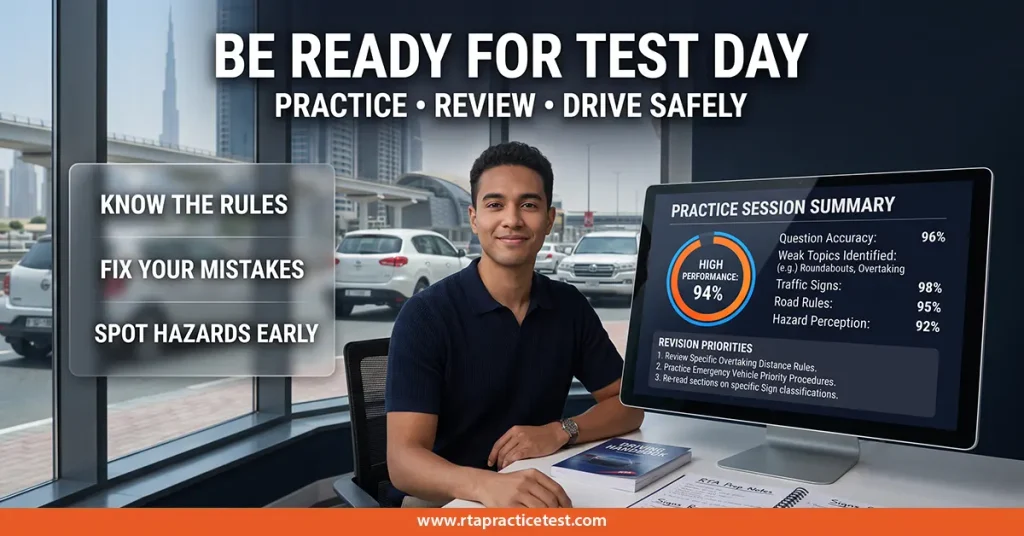
There is no legitimate shortcut that guarantees a pass.
The most reliable preparation is to combine official material + scenario practice + mistake review + hazard awareness.
A practical final-week routine could look like this:
7–5 days before the test
Study the handbook and traffic signs.
4–3 days before the test
Concentrate on road markings, intersections, roundabouts, lane discipline, and priority.
2 days before the test
Complete several practice sessions and review every mistake.
1 day before the test
Do a lighter revision session. Focus on weak areas rather than trying to learn an entirely new subject.
Test day
Bring the required documents and arrive early enough that you are not rushing into the assessment.
If you use a computer, tablet, or phone for practice, treat it as a learning tool—not as proof that the real exam will use exactly the same interface or questions.
Frequently Asked Questions
How many questions are on the RTA theory test?
A commonly referenced Dubai LMV theory-test format contains 40 questions, but candidates should confirm the current format with their driving institute or RTA because testing procedures can change.
What is the passing score for the RTA theory test?
The commonly cited requirement is 30 correct answers out of 40, equivalent to 75%. Confirm the current passing criteria before your appointment.
What happens if I fail the hazard perception section?
Do not assume that passing the other questions automatically means you have passed the complete assessment. Hazard-awareness requirements can be part of the overall assessment criteria. Ask your driving institute for the exact current retest rules if you do not pass.
What is the most important topic to study?
There is no single topic that replaces the others. Give particular attention to traffic signs, road markings, right-of-way, lane discipline, safe following distance, hazard perception, and defensive driving.
Is the RTA theory test difficult?
It can feel difficult if you only memorize answers. Scenario-based questions become easier when you understand why a particular action is safer.
Are online RTA practice questions exactly the same as the real test?
No third-party website should claim that its questions are guaranteed to be identical to the live RTA assessment. Online practice is best used to understand rules, improve recognition, and identify weak areas.
How can I improve my hazard perception?
Practice looking beyond the vehicle immediately in front of you. Scan the road ahead, mirrors, side areas, pedestrians, motorcycles, intersections, and vehicles that may change direction.
Final Thought
The best way to approach the RTA theory test is to stop thinking of it as a memory exam.
Think like a driver.
When you see a green light, look beyond the signal. When you see a pedestrian, think about what could happen next. When you follow a truck, consider its blind spots. When a vehicle begins braking ahead, identify the developing hazard before you are forced into an emergency stop.
Use RTA theory test questions and answers as a way to test your decision-making, not just your ability to remember option A, B, or C.
Start with the official RTA learning material, practice realistic scenarios, keep a record of your mistakes, and give extra attention to the areas where you repeatedly hesitate. That preparation is far more valuable than simply completing hundreds of random questions.