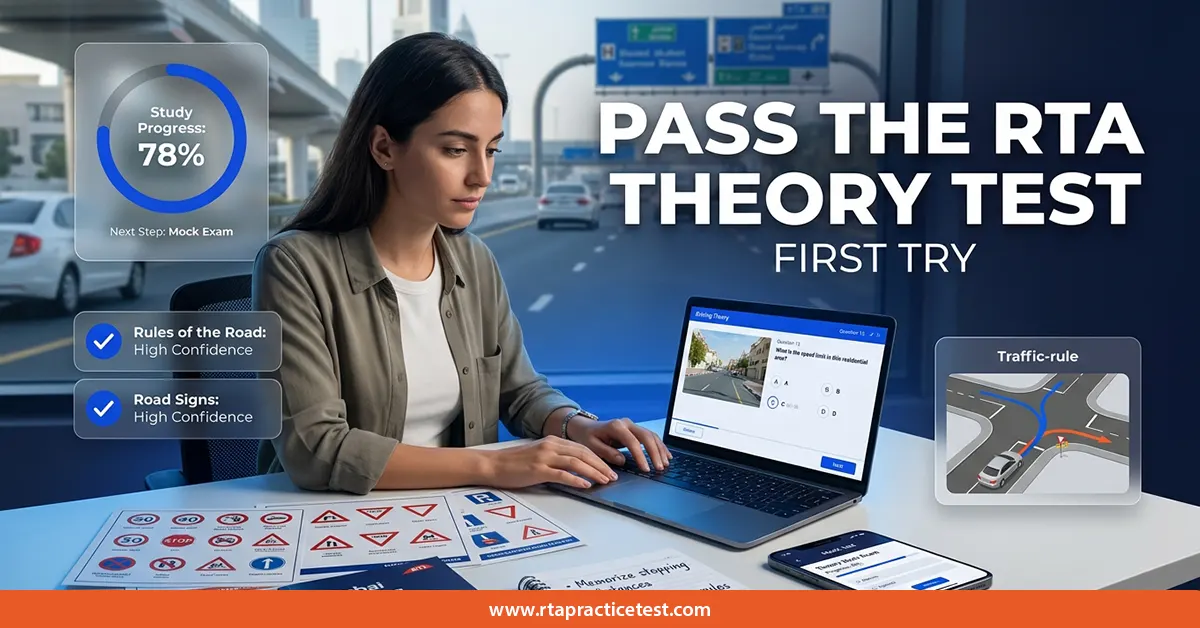
Passing the RTA theory test on your first attempt is less about memorizing hundreds of answers and more about understanding how Dubai Road rules work in real situations.
Many learner drivers make the same mistake: they spend hours answering random practice questions but do not understand why one answer is safer than another. That approach can work on a familiar mock test, but it becomes much harder when the wording or traffic situation changes.
A better strategy is to study the rules, recognize common road situations, practice questions regularly, and learn from every mistake.
This guide explains how to pass the RTA theory test first time in Dubai, what to study, how to use mock tests properly, which mistakes can hurt your score, and how to prepare during the final days before your exam.
Important: RTA test procedures, requirements, fees, and exam details can change. Always confirm the latest information through the official Dubai Roads and Transport Authority (RTA) before your test.
What You Actually Need to Know for the RTA Theory Test
The Dubai RTA theory test is designed to check whether a learner understands safe driving decisions rather than simply recognizing isolated facts.
That distinction is important.
For example, a question may not simply ask you to define a blind spot. Instead, it may describe a driver preparing to change lanes and ask what should happen before moving across. Knowing the term is useful, but understanding the complete driving process is much more valuable.
Start with the official learning material
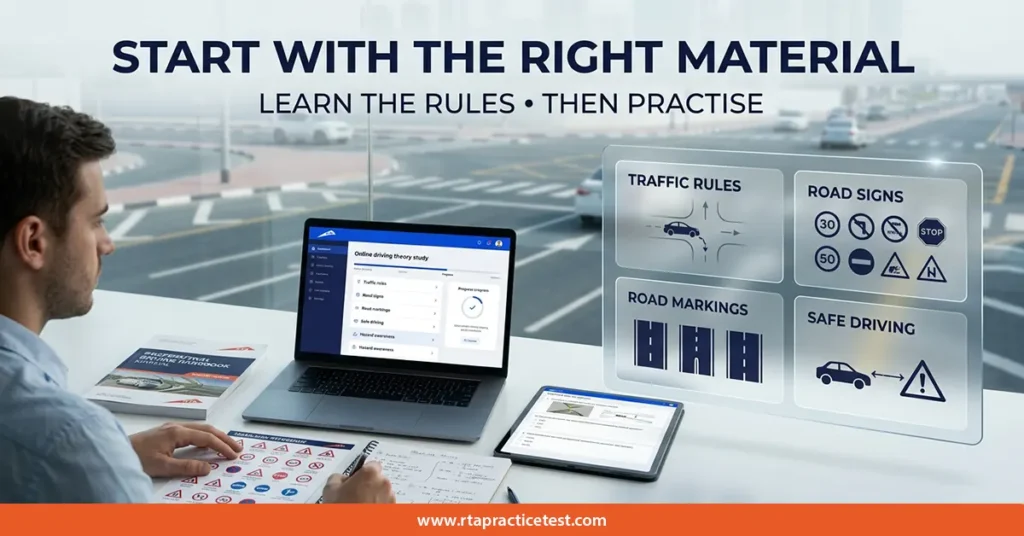
Your first source should be the driving-school material and official RTA guidance provided for your license category. The exact study material can vary depending on whether you are preparing for a light vehicle, motorcycle, heavy vehicle, or another category.
Use unofficial websites and practice tests as supplements, not replacements for the official learning material.
A practical study order is:
- Learn basic traffic rules.
- Study road signs and road markings.
- Understand lane positioning and right-of-way.
- Study defensive driving and hazard awareness.
- Practice situation-based questions.
- Take timed mock tests.
- Review every incorrect answer.
This order works better than jumping directly into hundreds of multiple-choice questions.
Learn the reason behind the rule
Suppose a practice question asks about following distance.
Do not memorize:
“The correct answer is X.”
Instead, understand:
“I need more space when visibility is poor, the road is slippery, traffic is unpredictable, or the vehicle ahead is large enough to block my view.”
Once you understand the principle, you can handle differently worded questions much more confidently.
That is one of the most useful RTA theory test tips for first-time candidates: learn the driving decision, not just the answer.
Build a mistake notebook
A simple notebook can make revision much more effective.
Create four columns:
| Question Topic | My Answer | Correct Answer | Why I Was Wrong |
| Lane changing | Moved immediately | Check surroundings first | Missed blind-spot risk |
| Roundabout | Entered quickly | Give priority correctly | Misread traffic flow |
| Road signs | Warning sign | Regulatory sign | Confused sign categories |
Review this notebook instead of repeatedly answering questions you already know.
That gives you a much clearer picture of where you are actually struggling.
Master the Road Signs, Markings, and Traffic Situations
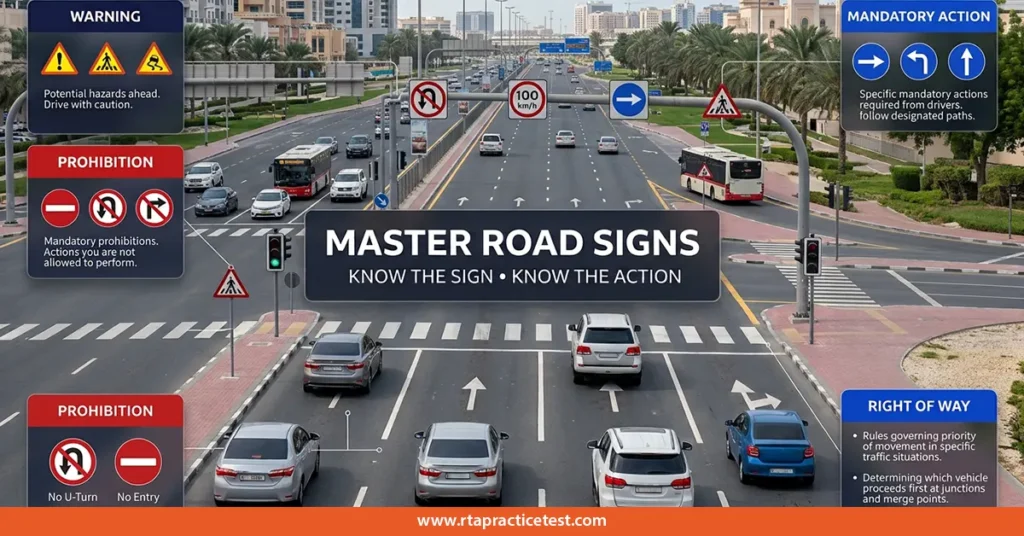
One of the easiest ways to improve your preparation is to stop treating road signs as a separate memorization exercise.
You should learn what the sign means and what action it requires from the driver.
Learn road signs by purpose:
Road signs represent one of the largest portions of the theory exam.
Focus on:
Warning Signs
These alert drivers to hazards ahead, including:
- Pedestrian crossings
- Curves
- Roundabouts
- School zones
- Animals crossing
- Roadworks
Regulatory Signs
These inform drivers about legal requirements.
Examples include:
- Stop
- Give Way
- No Entry
- No U-turn
- No Parking
- Speed Limits
Mandatory Signs
These instruct drivers what they must do.
Examples:
- Turn Left
- Turn Right
- Keep Left
- Straight Ahead
Information Signs
These help drivers navigate safely by identifying:
- Hospitals
- Parking
- Petrol stations
- Motorways
- Exits
Being able to identify signs instantly saves valuable time during the exam.
Use Mock Tests Properly Instead of Chasing Scores
Taking practice tests is one of the best ways to prepare for the Dubai RTA theory test, but only when you use them as a learning tool.
A common mistake is taking one mock test after another and celebrating a high score without reviewing mistakes.
That produces a misleading sense of confidence.
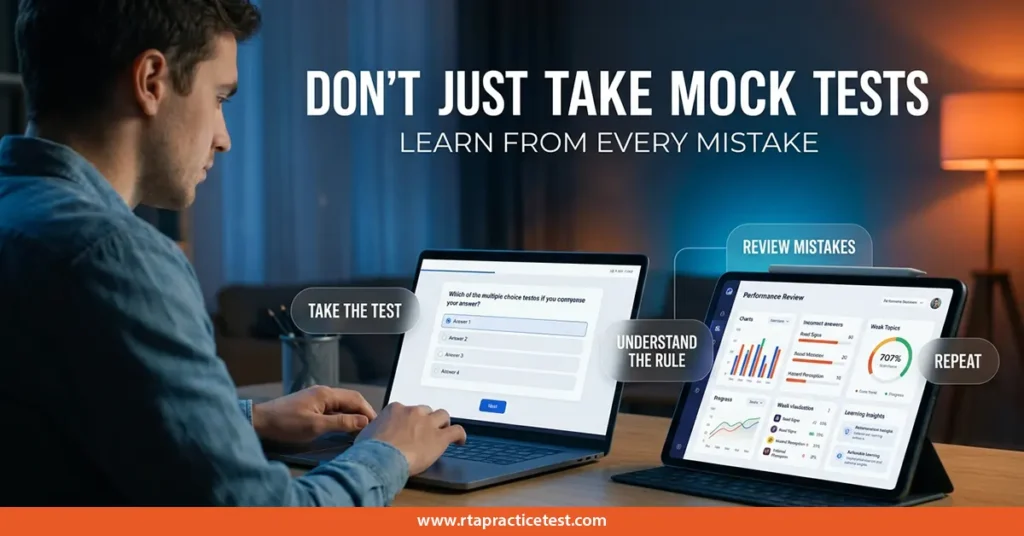
Follow a three-step mock-test method
For every practice test:
Step 1: Take the test without checking answers.
Treat it like the real exam. Avoid looking at notes while answering.
Step 2: Mark every uncertain question.
Even if you guessed correctly, record it. A correct guess is not the same as knowing the rule.
Step 3: Review wrong and uncertain answers.
Ask why your answer was wrong. Was it a road-sign issue? A misunderstanding of right-of-way? A rushed reading mistake?
This is where most learning happens.
Do not memorize the mock-test pattern
Imagine you answer a practice question five times and eventually remember:
“Option C is correct.”
That does not mean you understand the rule.
Now imagine the real question changes the road layout, vehicle position, or wording.
You may still make the same mistake.
A better approach is:
Question → rule → reason → correct action
That sequence creates stronger recall.
Create a realistic final-week routine
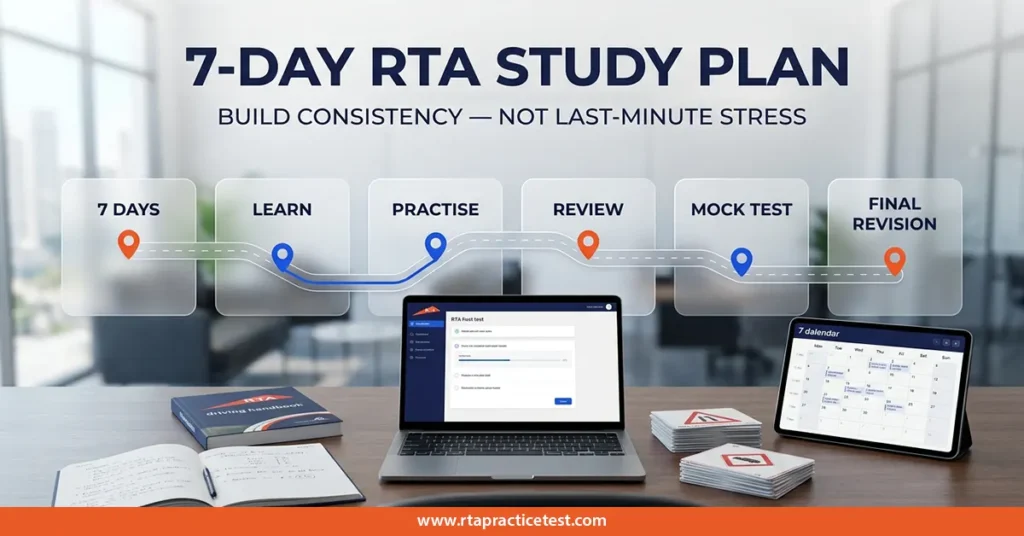
For many learners, a simple schedule is easier to follow than long study sessions.
7 days before the test
Focus on understanding rules, road signs, markings, and common driving situations.
5–6 days before the test
Start regular mock tests and record your weak areas.
3–4 days before the test
Concentrate on your weakest subjects instead of repeatedly reviewing everything.
2 days before the test
Take full practice tests under timed conditions and work on reading questions carefully.
The day before
Do light revision. Review your mistake notebook and important signs rather than trying to learn everything again.
The goal is to arrive at the exam alert—not exhausted.
Avoid the Mistakes That Cause Learners to Lose Easy Marks
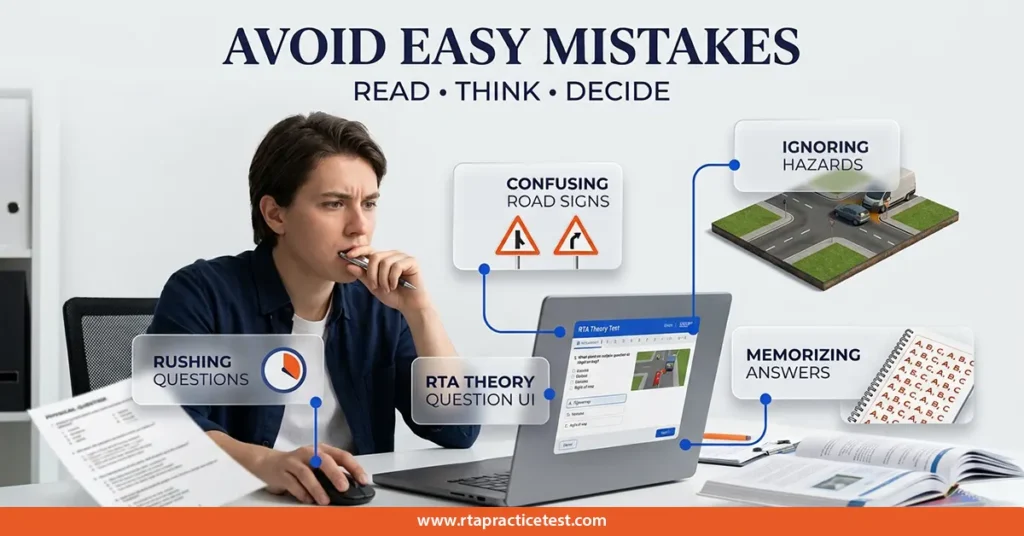
Some people fail because they do not know the rules. Others lose marks because they rush, misread a question, or rely too heavily on memorized answers.
The second group can often improve quickly.
Mistake 1: Reading only the last line of the question
A question may contain important information earlier in the scenario.
Words such as before, most appropriate, safest, first, or except can completely change the answer.
Read the entire question.
Mistake 2: Choosing the fastest action instead of the safest action
Learners sometimes select an answer because it appears efficient.
Driving theory generally rewards safe, controlled decision-making.
For example, when visibility is limited, the correct response is usually not to act more aggressively simply because there appears to be a gap.
Mistake 3: Ignoring vulnerable road users
Pedestrians, cyclists, and motorcyclists can be harder to see and are more exposed in a collision.
Whenever a question includes a vulnerable road user, slow down and examine the situation carefully.
Mistake 4: Confusing similar road signs
This is a classic revision problem.
Instead of staring at individual signs repeatedly, compare similar-looking categories side by side. Learn the visual difference and the practical action associated with each.
Mistake 5: Changing an answer without a good reason
There is a difference between reconsidering an answer and second-guessing yourself.
Change your answer when you identify a specific mistake in your original reasoning—not simply because you feel nervous.
Mistake 6: Taking too many mock tests without reviewing them
Ten tests with no analysis can be less useful than three tests with detailed error review.
Quality matters more than test count.
Mistake 7: Studying only the night before
Last-minute revision can help refresh memory, but it cannot replace proper preparation.
The best results usually come from repeated exposure over several days.
Mistake 8: Assuming online practice questions are official
Not every website uses RTA wording, current guidance, or the same question style as the official assessment.
Use practice websites to build knowledge and test readiness, but cross-check important rules with official RTA material.
A First-Attempt RTA Theory Test Strategy That Actually Works
The final part of preparation is not more information. It is having a reliable method for answering questions under pressure.
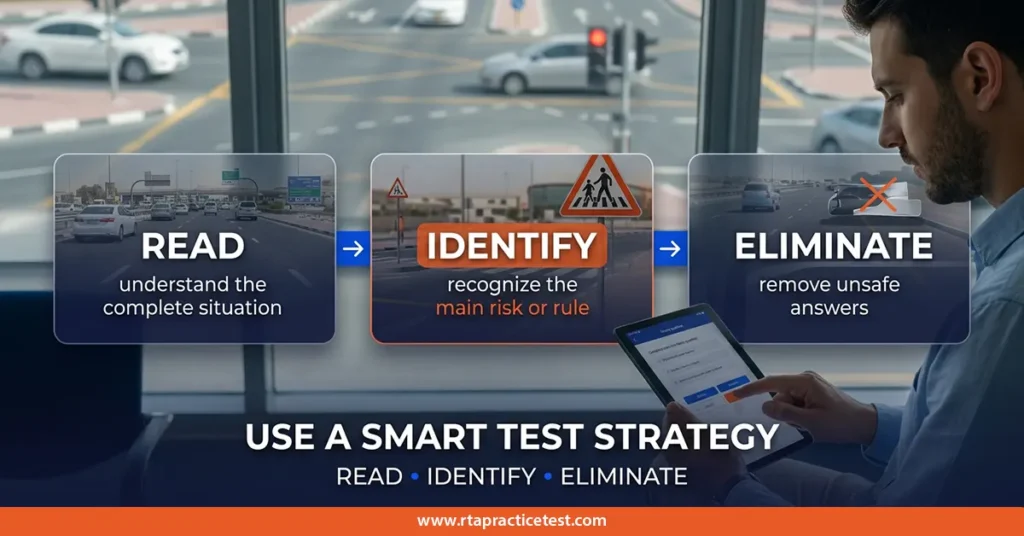
Use the “read, identify, eliminate” method
For every question:
Read: Understand the complete scenario.
Identify: Find the main risk, rule, or driving decision.
Eliminate: Remove answers that are obviously unsafe, illegal, unrealistic, or unrelated.
Choose: Select the answer that best matches safe and responsible driving behavior.
This is particularly useful when two options appear similar.
Slow down on scenario questions
Do not treat every question as a race.
A few extra seconds spent understanding a complicated situation can prevent an unnecessary mistake.
Pay attention to:
- Who has priority?
- Where is the hazard?
- What could happen next?
- What action reduces risk?
- Is the question asking what to do first?
- Is there an instruction hidden in the wording?
Keep real driving in your head while studying
One of the most effective ways to improve retention is to connect theory to actual roads.
When travelling as a passenger or during driving lessons, notice:
- How vehicles position themselves before turns
- How drivers approach intersections
- How lane markings guide traffic
- How pedestrians interact with crossings
- How drivers react to hazards
- Where blind spots may exist
You start seeing the theory as something practical rather than a collection of exam facts.
Know when you are ready
Do not judge readiness by one perfect mock-test score.
Look for consistency.
You are in a much stronger position when you can:
- Explain why an answer is correct.
- Recognize common signs quickly.
- Handle unfamiliar question wording.
- Identify hazards in road scenarios.
- Complete practice tests without rushing.
- Repeatedly perform well rather than scoring highly once.
That is a much better indicator of preparation than memorizing a fixed set of answers.
Frequently Asked Questions About the RTA Theory Test
How can I pass the RTA theory test on my first try?
Study the official learning material, understand traffic rules and road signs, practise realistic questions, and review every mistake. The strongest approach is to understand why an answer is correct instead of memorizing answer positions.
Is the RTA theory test difficult?
The difficulty depends heavily on preparation. Learners who understand traffic situations generally find unfamiliar questions easier than learners who rely only on memorized practice answers.
What should I study for the RTA theory test in Dubai?
Focus on traffic signs, road markings, right-of-way, lane discipline, safe following distance, hazard awareness, defensive driving, intersections, parking, vulnerable road users, and other rules relevant to your licence category.
Always use the current official RTA learning material for the exact requirements applicable to your test.
How many days should I study for the RTA theory test?
There is no single number that works for everyone. A structured study period spread across several days is generally more useful than one long last-minute session. Your preparation time should depend on how quickly you can understand the rules and consistently perform well in practice.
Are RTA theory test questions the same as online practice questions?
You should not assume that they are identical. Online practice tests are useful for learning concepts and becoming comfortable with multiple-choice questions, but official RTA materials should remain your primary reference.
What are the most common RTA theory test mistakes?
Common problems include rushing through questions, confusing road signs, misunderstanding right-of-way, ignoring vulnerable road users, choosing answers based on memory rather than reasoning, and failing to review incorrect practice answers.
Can I pass the RTA theory test without memorizing every question?
Yes. Understanding the rules is more useful than trying to memorize a fixed collection of questions. The wording and situation can vary, so knowing the underlying driving principle gives you more flexibility.
What should I do the night before the RTA theory test?
Avoid trying to learn an entire handbook overnight. Review your weak areas, road signs, mistake notes, and key driving principles. Get enough rest so you can read questions carefully during the exam.

Final Takeaway
Passing the RTA theory test on your first attempt is not about finding a shortcut or memorizing an answer sheet. It comes down to understanding the rules well enough to make the safe decision when the question is presented in an unfamiliar way.
Start with the official RTA learning material. Learn road signs by meaning and action. Practice realistic scenarios. Keep track of your mistakes. Use mock tests to measure understanding rather than simply chasing high scores.
Most importantly, prepare as though the purpose of the test is to help you become a safer driver—not simply to get through an exam.
That mindset changes the way you study, and it also makes the information much easier to remember when you eventually face real traffic on Dubai’s roads.